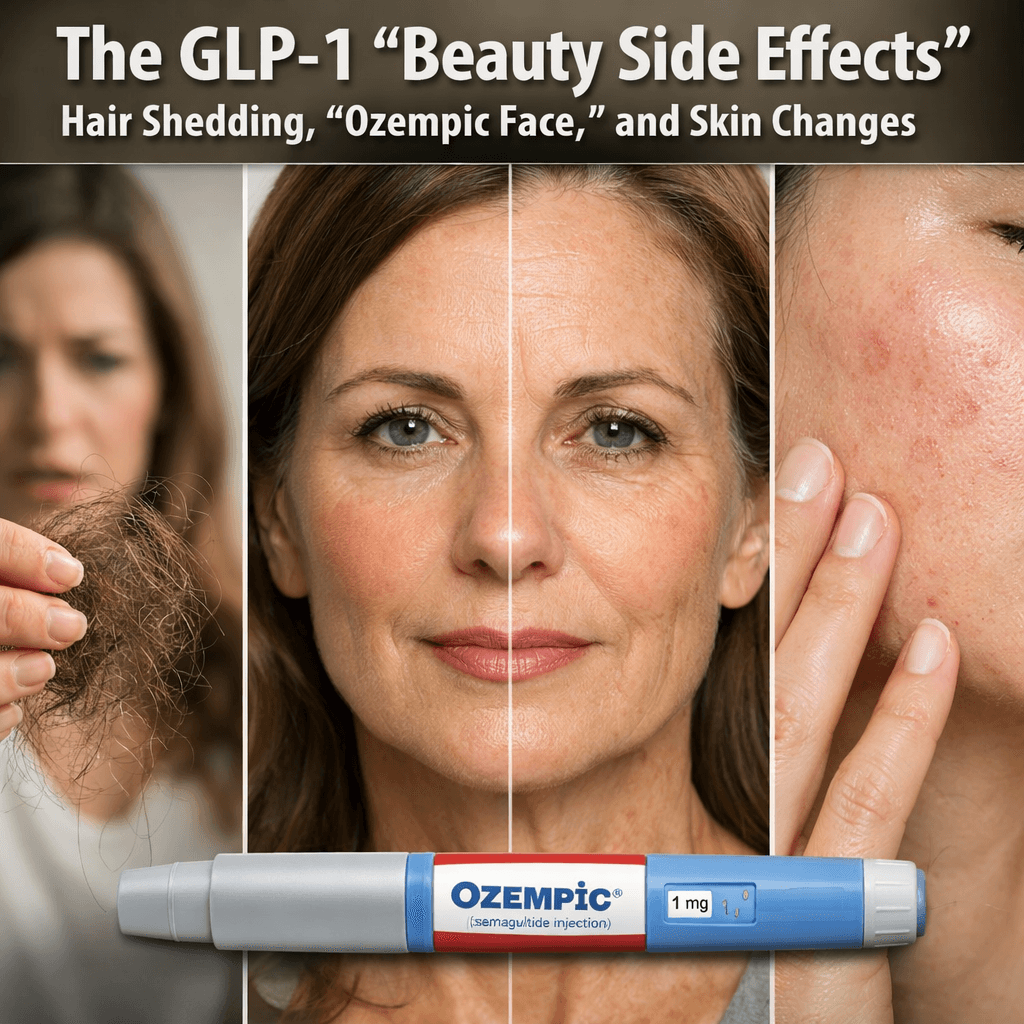
If you’ve been seeing phrases like “Ozempic face,” “Ozempic hair,” or “GLP-1 skin changes” all over TikTok and Reddit… you’re not imagining the trend. As GLP-1 medications (and GLP-1/GIP meds) became more common for weight management, people started noticing something that’s honestly pretty normal with rapid weight loss — your face can look different, hair can shed more than usual, and skin can feel like it’s “catching up.”
Here’s the key idea to keep your head straight:
Most of these changes are more about the speed and size of weight loss than about a “mystery side effect” unique to one medication.
This article is informational only — not medical advice. If you’re using a GLP-1 (or considering one), or even just starting a new exercise plan, talk to a licensed clinician who knows your history.
First: What people mean by “Ozempic face” (and why it happens)
“Ozempic face” is a nickname for a set of facial changes some people notice during fast weight loss:
- more hollowness in cheeks
- looser skin around jaw/neck
- wrinkles or lines that seem “new”
- a more gaunt look overall
The important clarification: it’s not a magical drug-specific facial side effect. It’s what can happen when you lose weight quickly — because you lose fat everywhere, including the face.
A clear explainer is from Cleveland Clinic, which describes “Ozempic face” as the facial changes that can happen with rapid weight loss, including gauntness, sunken cheeks, wrinkles, and loose skin — and notes it’s tied to the weight loss itself rather than the medication directly.
Why some people notice it more:
- Faster loss tends to show more abruptly
- Older adults have less “reserve” facial fat to begin with
- Genetics and baseline skin elasticity matter a lot
- Sun damage + smoking history can make skin less resilient
- The more weight lost, the more likely the face “shows it”
Hair shedding on GLP-1s: what the official labels and medical sources actually say
This is the part that freaks people out the most because it feels sudden: you’re washing your hair and it seems like… a lot.
1) Hair loss can show up in trial data (not always, but it’s real)
Some GLP-1-related meds list hair loss in clinical trial adverse reactions, and the label language is pretty blunt about what it’s associated with: weight reduction.
Examples:
- Wegovy (semaglutide) label shows hair loss reported in 3% of Wegovy-treated adults vs 1% with placebo (in that table of common adverse reactions).
- Zepbound (tirzepatide) label includes a “Hair Loss” section noting it was associated with weight reduction, and reports it more frequently in women than men in pooled studies (with specific female vs male percentages compared to placebo).
Those numbers don’t mean “this will happen to you.” They do mean it’s common enough to show up in controlled trial reporting.
2) The most common explanation is telogen effluvium (TE)
A lot of “Ozempic hair” stories line up with telogen effluvium, a type of temporary shedding triggered by stressors or major body changes — including rapid weight loss.
Cleveland Clinic’s medical library explains that in telogen effluvium, after a stressor or change to your body, a large portion of hairs can shift into the resting phase. Shedding tends to show up 2–3 months after the trigger, and in 95% of cases acute telogen effluvium resolves.
So if someone starts a medication in January, loses weight quickly through February/March, and then notices shedding in March/April… that timing is not random.
3) Appetite drop + nutrition gaps can make the situation worse
A separate Cleveland Clinic explainer on hair loss with GLP-1s emphasizes that hair shedding is usually tied to the body’s response to rapid weight loss, and also points out that eating less can raise the risk of nutrient shortfalls (like protein and certain minerals) if the person isn’t being careful.
This is where people get stuck: they feel too full to eat much, and the “less food” accidentally becomes “not enough nutrition.”
No, this article is not telling you what to eat or which supplements to take.
But it is saying: this is a clinician conversation worth having, especially if shedding is heavy or persistent.
Loose skin, “Ozempic neck,” and why skin elasticity matters
Skin changes during weight loss are not unique to GLP-1 users — but GLP-1s can accelerate weight loss enough that the skin feels like it can’t keep up.
Cleveland Clinic’s “Ozempic face” explainer notes that rapid weight loss can reduce facial fat and can be linked with changes in skin support/elasticity (collagen and elastin), which is why sagging can become more obvious.
Real-life factors that change the outcome:
- how quickly weight comes off
- age (elasticity naturally declines over time)
- total amount lost
- genetics
- baseline hydration and skin condition
- muscle mass and posture changes (sometimes the “frame” changes, not only fat)
Also worth saying plainly: some loose skin improves over time, and some doesn’t — it depends on those variables. That’s why internet before/after pictures are so misleading.
A simple “sanity check” timeline (so you don’t panic at the wrong moment)
This isn’t a guarantee — it’s just a helpful mental model based on how these processes are commonly described:
- Weeks 1–8: appetite changes, GI side effects are more common topics than hair/skin
- Months 2–4: if weight loss is rapid, facial changes may become noticeable; TE shedding can begin showing up around this window
- Months 4–6: some hair shedding patterns stabilize; body composition changes become more obvious; skin may start adapting (or not)
If something feels severe or sudden (like patchy bald spots rather than diffuse shedding), don’t self-diagnose from Reddit — bring it to a clinician.
What to ask your clinician (or telehealth provider) if appearance changes worry you
You don’t need to show up with a 40-question spreadsheet. A few clean questions can tell you if you’re being taken seriously:
For hair shedding
- “Does this look like telogen effluvium or something else?”
- “Is the timing consistent with weight-loss-related shedding?”
- “Should we rule out iron deficiency, thyroid issues, or other causes?”
- “What’s the plan if shedding continues past a few months?”
For facial changes / loose skin
- “Is my weight loss pace appropriate for my situation?”
- “Are there ways to structure this so it’s steadier?”
- “Should we adjust the plan if I’m losing too fast?”
For overall safety
- “What symptoms would you want me to report immediately?”
- “How often do we check in early on?”
That last question matters more than people think, because the quality of follow-up is what separates “fine, monitored care” from “good luck, see you later.”
If you’re using telehealth for GLP-1 care, support structure matters (a lot)
This is where many people feel lost: they’re doing GLP-1 care online, and when something stressful happens — shedding, fatigue, skin changes — they don’t know if it’s “normal,” temporary, or a sign to pause and reassess.
So here’s a practical way to evaluate any telehealth GLP-1 provider:
Look for these basics (fast checklist)
- Clear check-in schedule early on (not “as needed” with no details)
- A real way to message the care team (and realistic response expectations)
- A clinician relationship (name, credentials, and real follow-up)
- Clear pharmacy / fulfillment legitimacy signals (licensed pharmacy details)
- Transparency on what happens if side effects appear (not just marketing pages)
A real-world example of what “structured follow-up” looks like: LevelsRx
Instead of dropping a random brand mention, let’s use it for a specific point: how a telehealth program describes ongoing monitoring.
On its site, LevelsRx describes a typical flow (quiz → meet provider → medication shipped → progress tracking) and emphasizes that “support is always one message away.” It also explains that regular check-ins can be scheduled and that the frequency “usually” starts at about once a month in the beginning, where the provider evaluates progress, monitors medication tolerance, handles refills/labs, and adjusts the care plan as needed.
That kind of clarity is useful even if you never use LevelsRx — because it’s a concrete example of what you should be able to find in any program you’re trusting with medication-based weight management.
(And yes: always verify clinician licensing, pharmacy legitimacy, and program policies yourself. Don’t trust “trust signals” blindly.)
Don’t let social media decide what’s “normal” for you
TikTok loves extremes. Reddit loves conspiracy theories. Trustpilot loves motivated reviewers (positive and negative).
If you’re reading reviews about GLP-1 programs and trying to interpret hair/skin complaints, here’s how not to get played:
- Watch for timing details. Real experiences usually mention when it started.
- Be skeptical of absolutes. “Everyone gets this” and “no one gets this” are both usually wrong.
- Notice if the review is about support vs outcomes. Support quality is more verifiable.
- Be cautious with miracle fixes. If someone jumps straight into selling a product, treat it like an ad.
A better approach is: use reviews to identify the questions you should ask your provider, not to diagnose yourself.
Bottom line
- Facial changes and skin looseness are often tied to the pace of weight loss, not a “mystery cosmetic side effect.”
- Hair shedding is commonly explained as telogen effluvium triggered by rapid body changes, and timing usually shows up a couple months after the weight-loss trigger.
- Official prescribing information for some GLP-1/GIP meds includes hair loss reporting, and at least one label specifically links it to weight reduction.
- The safest move is not panic — it’s structured follow-up with a licensed clinician and a plan for monitoring.
And seriously: this isn’t medical advice. If you’re considering GLP-1s or even starting a new physical exercise routine, talk to a clinician first — especially if you have underlying health conditions.